Why Custom SoftwareBeats Off-the-Shelf Solutions
The Complete Guide to Choosing Between Custom Software and Ready-Made Solutions for Your Business
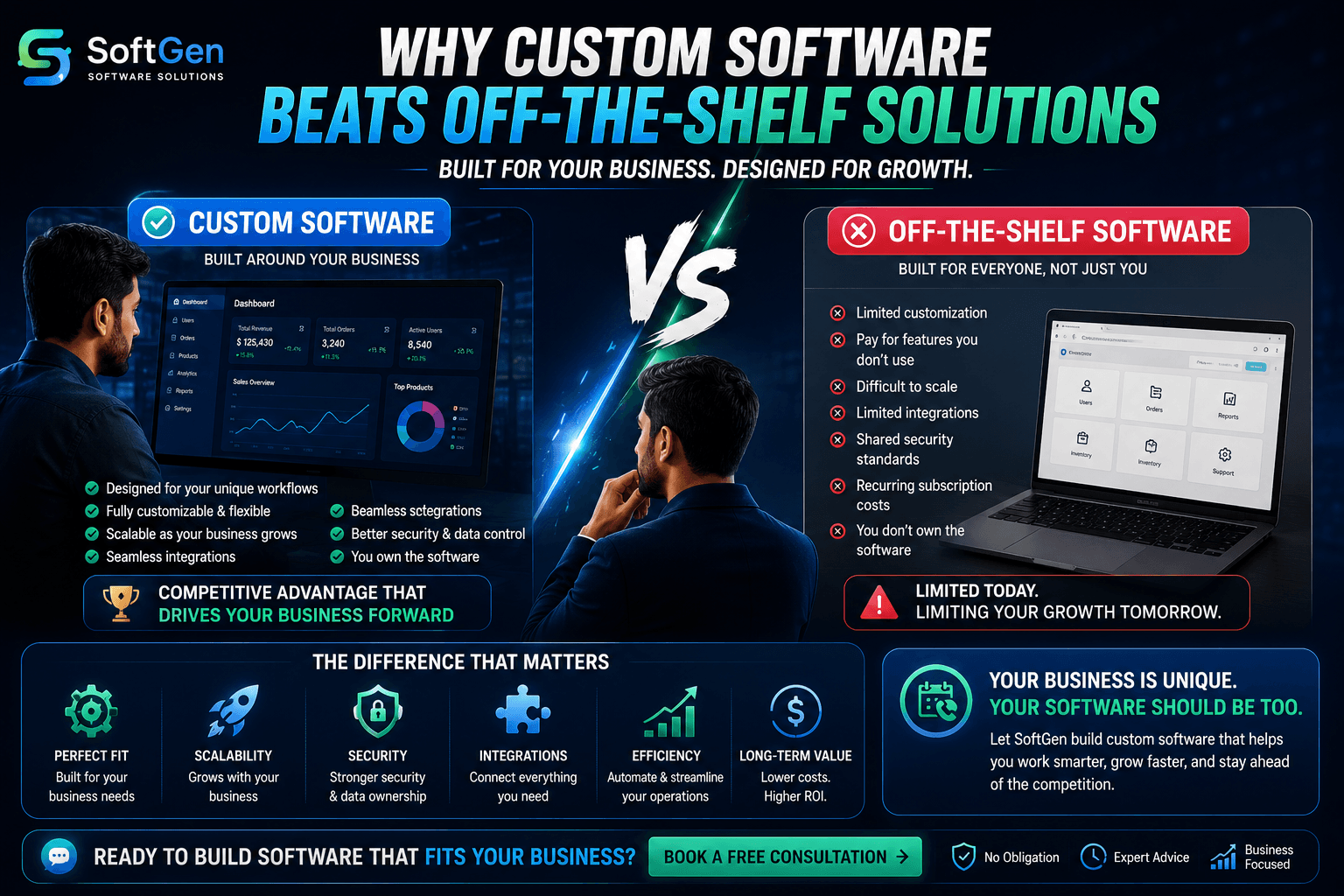
Custom Software vs Off-the-Shelf: Which One Does Your Business Actually Need?
Every growing business eventually faces the same decision: should you buy an existing software solution or invest in building something custom?
The answer depends on your business model, competitive landscape, budget, and long-term goals. There is no universally right choice — but there is a right choice for your specific situation.
This guide breaks down the real differences between custom software and off-the-shelf products, helps you understand when each approach makes sense, and gives you a clear framework for making the right decision.
What Is Custom Software?
Custom software is built from the ground up for your specific business needs. Unlike ready-made products, it is designed around your exact workflows, users, and data requirements.
What Is Off-the-Shelf Software?
Off-the-shelf software (also called commercial off-the-shelf or COTS) is pre-built products designed to serve a broad market. Examples include Salesforce, HubSpot, QuickBooks, Monday.com, and Notion.
These products work well for standard use cases but often fall short when your business processes don't match the software's assumptions.
Free Software Strategy Consultation
Not Sure Which Option Is Right for You?
Our engineering team will analyze your business requirements, compare options, and recommend the most cost-effective approach - completely free, with no obligation.
Custom Software vs Off-the-Shelf: 8 Key Factors
Customization
Fully tailored to your workflow, roles, and business rules
Limited configuration options, workarounds often required
Scalability
Built to grow with your user base, data volume, and feature needs
Performance degrades as usage grows, vendor roadmap dictates limits
Integration
Connects seamlessly with your existing tools, APIs, and databases
Limited integrations, often requires third-party middleware or manual data entry
Security
Security architecture designed for your specific threat model and compliance needs
Generic security, shared vulnerability exposure across all users
Long-Term Cost
Higher upfront, significantly lower over 3-5 years as no licensing fees
Lower upfront, recurring subscriptions compound over time
Ownership
You own the code, full control over updates and features
Vendor controls updates, pricing, feature roadmap, and can discontinue the product
Time to MVP
4-12 weeks depending on scope, focused on core features first
Immediate but often requires months of configuration and training
Maintenance
Ongoing support, bug fixes, and feature improvements tailored to your needs
Vendor releases updates on their schedule, may break existing workflows
The Real Cost Comparison Over 5 Years
Most businesses compare only the upfront costs. But the true cost picture looks very different when you factor in subscriptions, customization, and opportunity costs over time.
* Estimates based on typical mid-market business scenarios. Actual costs vary by complexity and vendor pricing.
When Custom Software Is the Right Choice
- Your business has unique workflows that generic tools can't accommodate
- You handle sensitive data requiring compliance with HIPAA, GDPR, or PCI-DSS
- You need deep integrations with multiple internal systems and third-party APIs
- Your business is scaling rapidly and needs software that grows with you
- You want to differentiate through proprietary technology and data
- You plan to monetize the software as a product or platform
When Off-the-Shelf Software Makes Sense
- You need a solution up and running immediately with minimal setup
- Your team has standard workflows that common tools already support
- Budget is extremely tight and you can't justify upfront development costs
- You're a small business with simple, non-competitive requirements
- The software category is mature with well-established market leaders
How SoftGen Helps You Make the Right Decision
At SoftGen, we don't push custom software on every business. We provide an honest assessment of your needs and recommend the approach that delivers the best long-term value.
Quick Decision Framework
Use this framework to quickly evaluate which approach makes more sense for your situation.
- ✓ You have unique business processes
- ✓ You plan to scale significantly
- ✓ You need deep integrations
- ✓ Data security is critical
- ✓ You want to own the technology
- ✓ You need a solution immediately
- ✓ Your workflows are standard
- ✓ Budget is very limited
- ✓ You're a small team
- ✓ You don't need competitive differentiation
Final Thoughts
The choice between custom software and off-the-shelf solutions isn't about which is objectively better — it's about which approach aligns with your specific business goals, budget, and growth trajectory.
For businesses with unique requirements, compliance needs, or competitive differentiation goals, custom software almost always delivers superior long-term value. For simpler needs with standard workflows, off-the-shelf tools can be a practical starting point.
The most important thing is making this decision strategically, not by default. Understanding the true cost, trade-offs, and long-term implications helps you invest wisely.
Frequently Asked Questions
Why is custom software better than off-the-shelf?
Custom software is built specifically for your business needs. It fits your workflows perfectly, scales with your growth, integrates with your existing tools, and you own it completely without recurring licensing fees.
How much does custom software cost?
Costs vary based on complexity. A focused MVP typically ranges from $15,000 to $50,000. Enterprise platforms can range from $50,000 to $200,000+. The long-term ROI often exceeds off-the-shelf solutions within 2-3 years.
How long does custom software take to build?
A focused MVP typically takes 4-8 weeks. A full-featured platform takes 8-16 weeks. Complex enterprise systems take 12-24 weeks. The timeline depends on scope, complexity, and integration requirements.
Can custom software replace existing tools?
Yes. Many businesses replace multiple subscription tools with a single custom platform that consolidates features, reduces costs, and provides a unified experience tailored to their operations.
What about ongoing maintenance?
Custom software requires ongoing support for security updates, bug fixes, and feature improvements. Most businesses invest 15-20% of the initial development cost annually for maintenance and enhancements.
Ready to Make the Right Software Investment?
Let's build what your business actually needs
Whether you need custom software, off-the-shelf guidance, or a hybrid approach, SoftGen helps businesses make strategic technology decisions that drive real results.